


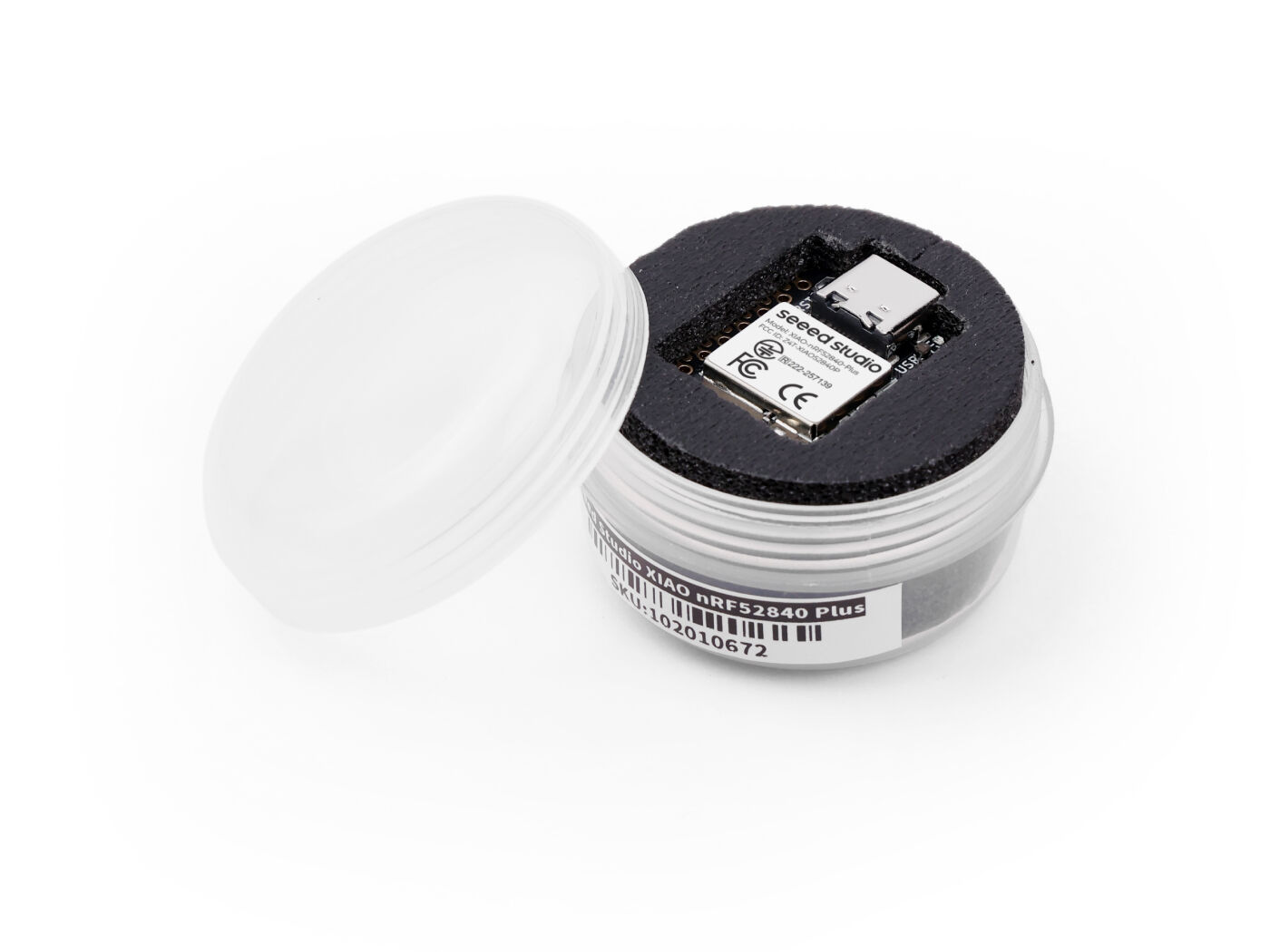
Product Details
The Seeed Studio XIAO nRF52840 Plus gives compact Bluetooth projects more room for peripherals: 20 GPIOs, including nine extra connections on 1.27 mm SMD castellations. It keeps the Nordic nRF52840 MCU and integrated Li-ion charging, with support for Arduino and CircuitPython.
Why You Want It
Choose Plus when the standard XIAO runs out of I/O and you are building a custom carrier board. The extra GPIOs need SMD board-to-board soldering; they are not nine more pins on the usual header rows. Plan the carrier layout before warming up the iron.
Choose your XIAO nRF52840
The standard XIAO nRF52840 has 11 digital I/O. The XIAO nRF52840 Plus adds nine GPIOs through 1.27 mm SMD castellations for board-to-board soldering. Choose the XIAO nRF52840 Sense if you need an onboard 6-axis IMU and PDM microphone; those sensors are not fitted to the non-Sense boards.
Pinout and setup
Use the nRF52840 series hardware overview and Plus pinout alongside the getting-started guide above. Select the Plus board view before planning the extra connections.
For more selection help, see standard nRF52840 vs Sense and our Arduino setup guide.
Specifications
- Processor: Nordic nRF52840, ARM® Cortex®-M4 32-bit with FPU @ 64 MHz
- Wireless Connectivity: Bluetooth 5.0 / BLE / NFC
- Memory: 256KB RAM
- Storage: 1MB On-chip Flash + 2MB Onboard QSPI Flash
- GPIO: 20 Total Pins (20 PWM/ 6 Analog capable)
- Interfaces: 1x I2C, 2x UART, 2x SPI, 1x I2S
- Battery Management: BQ25101 Chip (Integrated Li-ion charging)
- User Interface: 1x Reset Button, 1x 3-in-1 LED, 1x Charge LED
- Input Voltage: 5V (USB-C) or 3.7V (Battery)

What’s in the Box
- 1× Seeed XIAO nRF52840 Plus Development Board
Product Notes
Compatible with Arduino, MicroPython, and CircuitPython. Requires a USB-C cable (not included, because you definitely have twelve of them already).
Before you order
If your build needs pin headers, please contact us before ordering so we can confirm what is supplied with the current batch.
Still Here?
Check the pinout against your carrier board, then give that next compact build a little more I/O to work with.