


Product Details
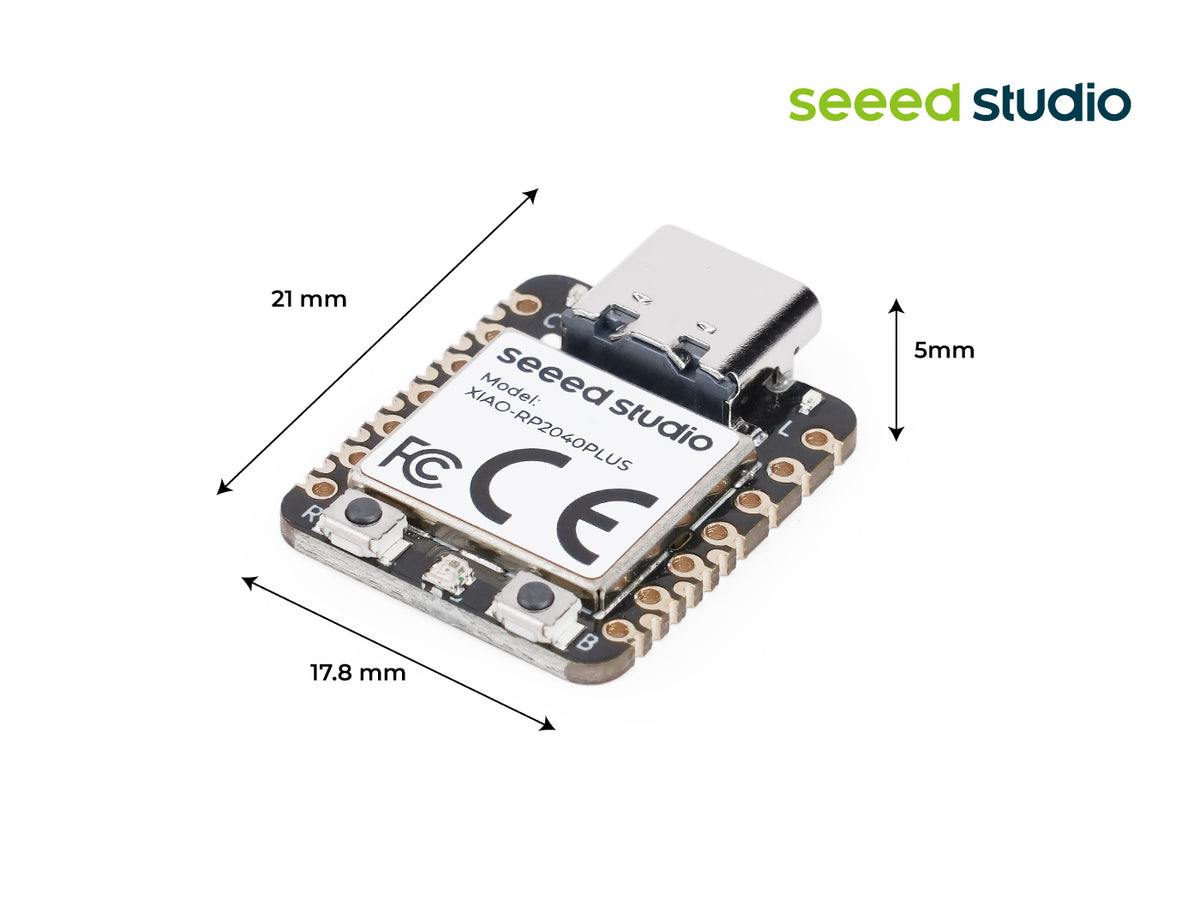
RP2040 power without turning your project into a flying breadboard. The XIAO RP2040 Plus packs a dual-core 133 MHz MCU, 15 extra SMD GPIOs and onboard Li-ion battery management into Seeed's tiny 21 × 17.8 mm footprint.
Why You Want It
It is a compact route into the huge RP2040 ecosystem, complete with PIO state machines for the oddly specific timing jobs that normally become a late-night firmware problem. Extra I/O and battery monitoring make the Plus version far more comfortable in wearables, sensor nodes, robots and custom PCBs.
Standard or Plus?
The standard XIAO RP2040 is the simpler choice if its usual header-row I/O is enough. Plus adds 15 GPIOs on 1.27 mm SMD castellations and onboard Li-ion charging. The extra connections need SMD soldering or a suitable custom carrier; fitting the two 7-pin headers does not bring every Plus GPIO onto a breadboard.
Setup and pinout
Start with Seeed’s RP2040 series guide and standard/Plus pin map. Check the board definition and pin mapping for your chosen Arduino or MicroPython setup; the extra Plus pads are worth checking before you commit the PCB.
For a battery-powered data logger, the onboard sensing circuit lets your firmware monitor battery voltage. A3/GPIO29 is shared: it cannot also serve as general-purpose I/O while measuring the battery. See the battery-voltage example before assigning that pin elsewhere.
Still choosing between processors? Read our XIAO RP2040 Plus vs SAMD21 Plus comparison, then check the matching pin map.
Specifications
- MCU: Raspberry Pi RP2040 with dual ARM Cortex-M0+ cores at up to 133 MHz
- Memory: 2 MB onboard Flash and 264 KB SRAM
- GPIO: 26 digital I/O with PWM capability, of which 4 support analogue input; these functions share pins
- Extra I/O: 15 additional GPIOs on 1.27 mm SMD castellations
- Interfaces: 2× I²C, 1× UART and 1× SPI
- USB: USB Type-C
- Battery Management: Onboard PMIC with Li-ion charging and software-controlled battery-voltage monitoring
- Battery Monitoring: GPIO24 enables sensing; GPIO29/A3 reads battery voltage
- Onboard Controls: Reset button and Boot button
- Indicators: User LED, charge LED and programmable RGB LED
- Input: 5 V by USB Type-C or BAT input
- Dimensions: 21 × 17.8 mm (small board, suspiciously long project list)
- Operating Temperature: -20°C to 70°C
- Software Support: Arduino, PlatformIO, MicroPython, CircuitPython, C/C++ SDK, TinyGo, Rust and Zephyr
What's in the Box*
- 1× Seeed Studio XIAO RP2040 Plus
- 2× 7-pin headers
Disclaimer
*Battery and USB cable are not included. PIO can solve many timing problems, but it cannot stop you starting three new projects before finishing the first one.
Still Here?
Either you are comparing every RP2040 board on the internet (respect) or you already know this one fits. Pop it in the cart and reclaim some space in your build.